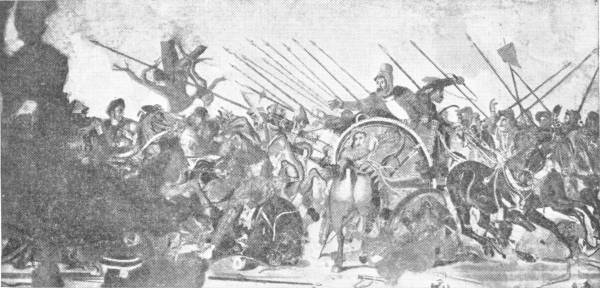
In 334 B.C.—for two years were needed to establish and confirm his position in Macedonia and Greece—he crossed into Asia, defeated a not very much bigger Persian army at the battle of the Granicus and captured a number of cities in Asia Minor. He kept along the sea-coast. It was necessary for him to reduce and garrison all the coast towns as he advanced because the Persians had control of the fleets of Tyre and Sidon and so had command of the sea. Had he left a hostile port in his rear the Persians might have landed forces to raid his communications and cut him off. At Issus (333 B.C.) he met and smashed a vast conglomerate host under Darius III. Like the host of Xerxes that had crossed the Dardanelles a century and a half before, it was an incoherent accumulation of contingents and it was encumbered with a multitude of court officials, the harem of Darius and many camp followers. Sidon surrendered to Alexander but Tyre resisted obstinately. Finally that great city was stormed and plundered and destroyed. Gaza also was stormed, and towards the end of 332 B.C. the conqueror entered Egypt and took over its rule from the Persians.