In the fourteenth century there was a brief revival of Mongol vigour under Timurlane, a descendant of Jengis Khan. He established himself in Western Turkestan, assumed the title of Grand Khan in 1369, and conquered from Syria to Delhi. He was the most savage and destructive of all the Mongol conquerors. He established an empire of desolation that did not survive his death. In 1505, however, a descendant of this Timur, an adventurer named Baber, got together an army with guns and swept down upon the plains of India. His grandson Akbar (1556-1605) completed his conquests, and this Mongol (or “Mogul” as the Arabs called it) dynasty ruled in Delhi over the greater part of India until the eighteenth century.
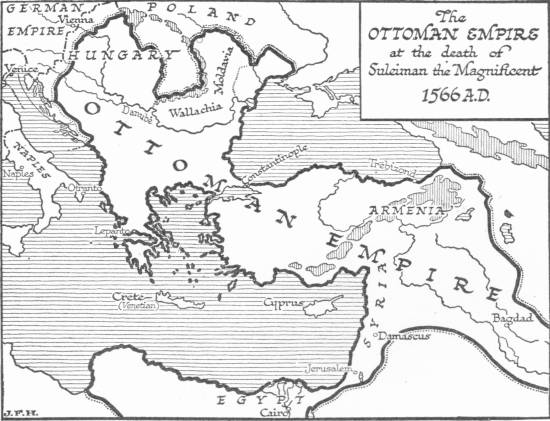
One of the consequences of the first great sweep of Mongol conquest in the thirteenth century was to drive a certain tribe of Turks, the Ottoman Turks, out of Turkestan into Asia Minor. They extended and consolidated their power in Asia Minor, crossed the Dardanelles and