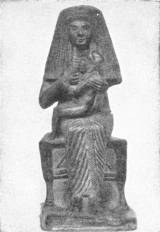
After the Greek conquest, the new city of Alexandria became the centre of Egyptian religious life, and indeed of the religious life of the whole Hellenic world. A great temple, the Serapeum, was set up by Ptolemy I at which a sort of trinity of gods was worshipped. These were Serapis (who was Osiris-Apis rechristened), Isis and Horus. These were not regarded as separate gods but as three aspects of one god, and Serapis was identified with the Greek Zeus, the Roman Jupiter and the Persian sun-god. This worship spread wherever the Hellenic influence extended, even into North India and Western China. The idea of immortality, an immortality of compensations and consolation, was eagerly received by a world in which the common life was hopelessly wretched. Serapis was called “the saviour of souls.” “After death,” said the hymns of that time, “we are still in the care of his providence.” Isis attracted many devotees. Her images stood in her temples, as Queen of Heaven, bearing the infant Horus in her arms. Candles were burnt before her, votive offerings