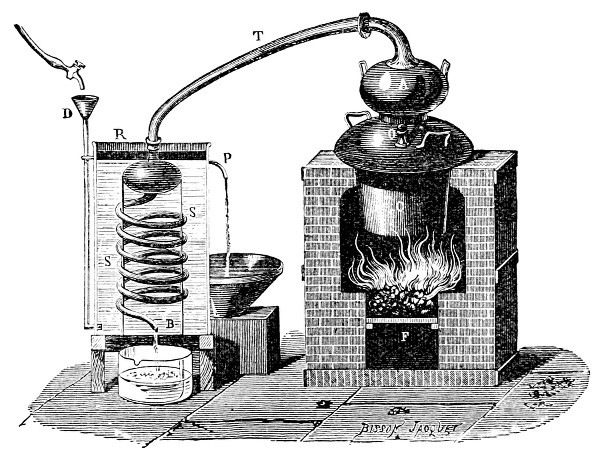
 Fig. 4.—Distillation by means of a metallic still. The liquid in C is heated by the fire F. The vapours rise through the head A and pass by the tube T to the worm S placed in a vessel R, through which a current of cold water flows by means of the tubes D and P. Distilled water may be prepared, or distillation in general carried on, either in a metal still with worm condenser (fig. 4) or on a small scale in the laboratory in a glass retort (fig. 5) heated by a lamp. Fig. 5 illustrates the main parts of the usual glass laboratory apparatus used for distillation. The steam issuing from the retort (on the right-hand side) passes through a glass tube surrounded by a larger tube, through which a stream of cold water passes, by which the steam is condensed, and runs into a receiver (on the left-hand side).
 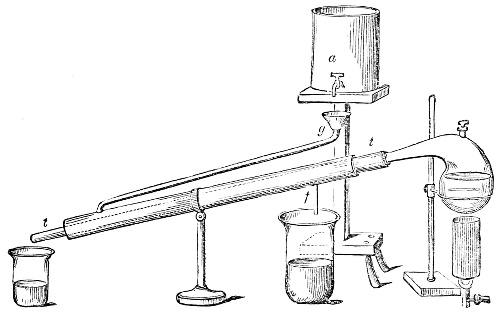 Fig. 5.—Distillation from a glass retort. The neck of the retort fits into the inner tube of the Liebig's condenser. The space between the inner and outer tube of the condenser is filled with cold water, which enters by the tube g and flows out at f.
Table of Contents
7
377