Strong acetic acid (C2H4O2), whose specific gravity at 15° is 1·055, does not become lighter on the addition of water (a lighter substance, sp. gr. = 0·999), but heavier, so that a solution of 80 parts of acetic acid and 20 parts of water has a specific gravity of 1·074, and even a solution of equal parts of acetic acid and water (50 p.c.) has a sp. gr. of 1·065, which is still greater than that of acetic acid itself. This shows the high degree of contraction which takes place on solution. In fact, solutions—and, in general, liquids—on mixing with water, decrease in volume.
Graham, in the jelly formed by gelatine, and De Vries in gelatinous silica (Chapter XVIII.) most frequently employed coloured (tinted) substances, for instance, K2Cr2O7, which showed the rate of diffusion with very great clearness. Prof. Oumoff employed the method described in Chapter X., Note 122, for this purpose.
The researches of Graham, Fick, Nernst, and others showed that the quantity of a dissolved substance which is transmitted (rises) from one stratum of liquid to another in a vertical cylindrical vessel is not only proportional to the time and to the sectional area of the cylinder, but also to the amount and nature of the substance dissolved in a stratum of liquid, so that each substance has its corresponding co-efficient of diffusion. The cause of the diffusion of solutions must be considered as essentially the same as the cause of the diffusion of gases—that is, as dependent on motions which are proper to their molecules; but here most probably those purely chemical, although feebly-developed, forces, which incline the substances dissolved to the formation of definite compounds, also play their part.
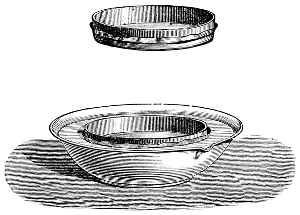 Fig. 15.—Dialyser. Apparatus for the separation of substances which pass through a membrane from those which do not. Description in text. The rate of diffusion—like the rate of transmission—through membranes, or dialysis (which plays an important part in the vital processes of organisms and also in technical processes), presents, according to Graham's researches, a sharply defined change in passing from such crystallisable substances as the majority of salts and acids to substances which are capable of giving jellies (gum, gelatin, &c.) The former diffuse into solutions and pass through membranes much more rapidly than the latter, and Graham therefore distinguishes between crystalloids, which diffuse rapidly, and colloids, which diffuse slowly. On breaking solid colloids into pieces, a total absence of cleavage is remarked. The fracture of such substances is like that of glue or glass. It is termed a ‘conchoidal’ fracture. Almost all the substances of which animal and vegetable bodies consist are colloids, and this is, at all events, partly the reason why animals and plants have such varied forms, which have no resemblance to the crystalline forms of the majority of mineral substances.