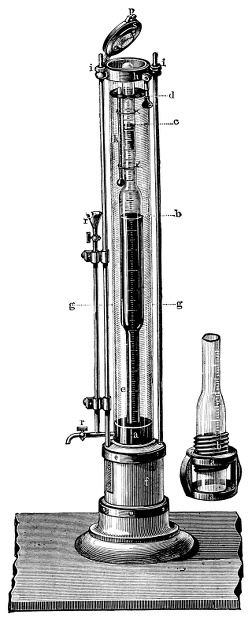
 Fig. 16.—Bunsen's absorptiometer. Apparatus for determining the solubility of gases in liquids. The solubility, or co-efficient of solubility, of a substance is determined by various methods. Either a solution is expressly prepared with a clear excess of the soluble substance and saturated at a given temperature, and the quantity of water and of the substance dissolved in it determined by evaporation, desiccation, or other means; or else, as is done with gases, definite quantities of water and of the soluble substance are taken and the amount remaining undissolved is determined. The solubility of a gas in water is determined by means of an apparatus called an absorptiometer (fig. 16). It consists of an iron stand f, on which an india-rubber ring rests. A wide glass tube is placed on this ring, and is pressed down on it by the ring h and the screws i i. The tube is thus firmly fixed on the stand. A cock r, communicating with a funnel r, passes into the lower part of the stand. Mercury can be poured into the wide tube through this funnel, which is therefore made of steel, as copper would be affected by the mercury. The upper ring h is furnished with a cover p, which can be firmly pressed down on to the wide tube, and hermetically closes it by means of an india-rubber ring.
Table of Contents
22
446